 日本語
日本語
It's not so common to find games for the MZ-1500, but applications are that much rarer. A bit ago, I found two boxed applications with manuals, it was quite a surprise! This one is called Can Can, it's a Japanese word processor. You already know it's a little bit special, because they actually put their label on in a sensible manner, so both the label and the case can be upright at the same time. So far, they're the only ones to do it that I've seen. 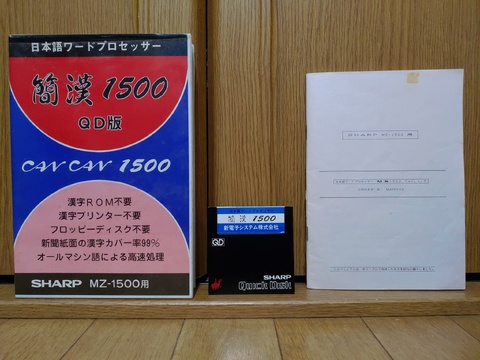 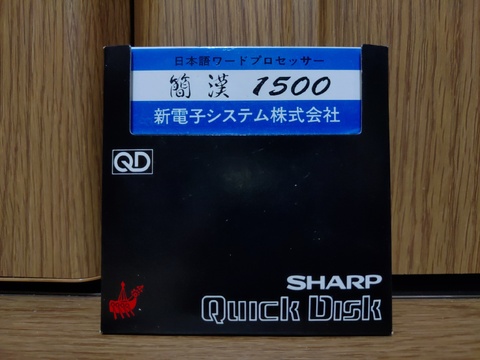 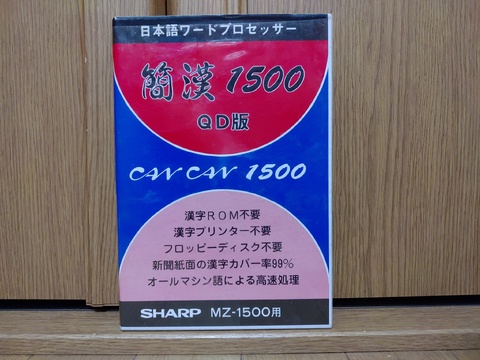 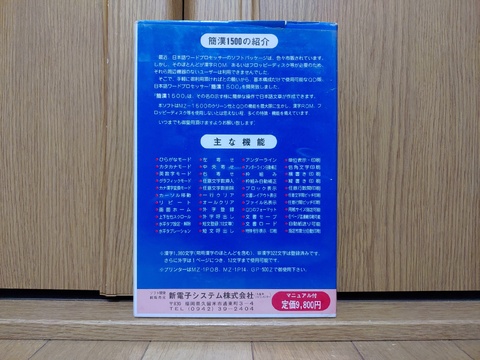 The usage is really quite similar to other Japanese word processors of the era, but it has one unusual feature - it can display kanji but it doesn't require a kanji ROM. The range of kanji it can display is not as wide as one would get with a Japanese word processor that uses a kanji ROM, but it isn't shabby at 1915 kanji. It also has standard characters like hiragana, katakana, upper- and lower-case letters, and a handful of graphic characters.    Kanji entry is a bit easier than I've seen on other Japanese word processors. First, press the break key. It will ask you to enter the reading at the bottom right. Unlike most processors, instead of just entering the first symbol of the Chinese reading, you enter the whole reading, which is usually between one and three characters. Press enter, and it will show you a list of kanji that match what you entered. So for example, to enter 夏休み, first press break, enter カ, and press the 9 key. Press break again. Yep, it's one character at a time. Next we'll type in キュウ and press enter. This time press 3. み is hiragana, so just enter that directly from the keyboard. Tada! This word is fairly smooth because both kanji fall in the range of あ~さ, which is stored in memory. If you use anything from し and beyond, it has to look up the character data on the QuickDisk. Fortunately, we love the sound of the whirring QuickDisk, right?   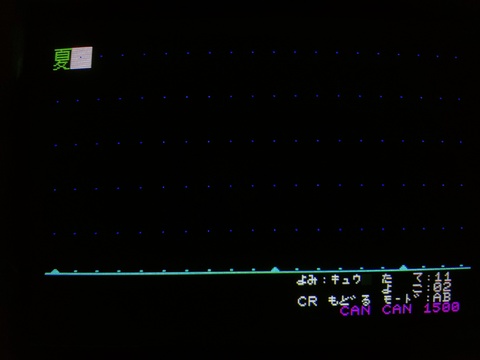 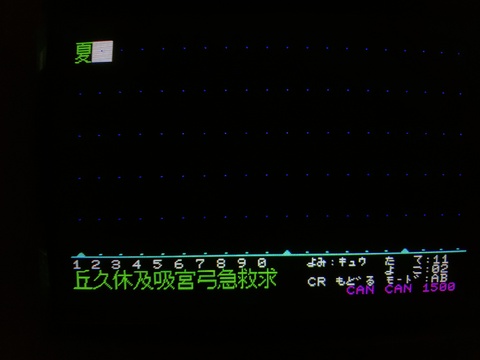 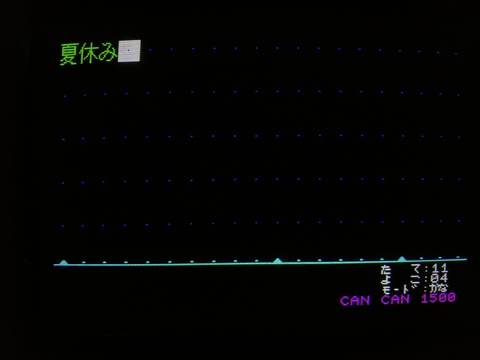 You can enter units of measurement in a similar way, but instead of pressing break, you press ctrl-T. For example, let's talk about my gigantic house. I used 140 cubic meters, and oh hey, I just realized I am a moron. Nobody measures a house in cubic meters! Oh well, the screenshot is done and I'm not going back to that anytime too soon, so let's talk about a theoretical 140 cubic meter house. There are probably Tokyo apartments about that size. Anyway, look at that, there's no cubic meter symbol when we press ctrl-T. If the symbol you want isn't listed on that row, navigate rows using the up and down arrows. Same when you are entering kanji. 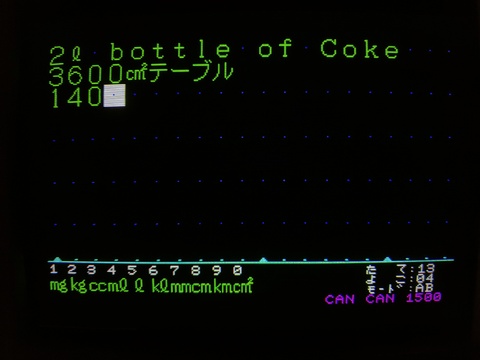 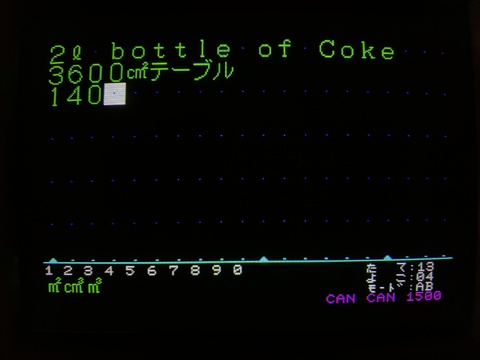 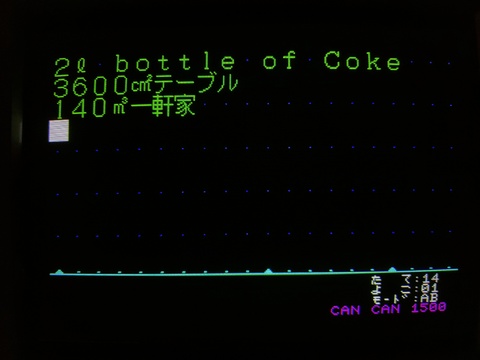 |
| 八 ビ ッ ト hachibitto |